
Key takeaways
- Most businesses aren’t ready for AI, and the blocker is data, not budget.
- AI implementations fail when operational data is fragmented across spreadsheets, email threads, and disconnected tools. There’s nothing clean for the model to work with.
- The honest readiness checklist: a single source of truth for operational data, documented processes, integrated tools, and clear success metrics for each AI use case.
- The right sequence is foundation first (clean data + connected systems + automation), then AI on top, not AI bolted onto chaos.
Almost every founder I talk to right now has some version of the same question: is my business ready for AI?
They’ve seen the demos. They’ve had team members suggest ChatGPT for this or AI agents for that. They’re watching competitors mention AI in their marketing and wondering if they’re falling behind. There’s a real sense that something important is moving fast and they need to be doing something about it.
Here’s my honest answer: most businesses aren’t ready for AI. But it has nothing to do with their budget, their team size, or which software they’re using. The real problem is almost always the same thing. Their data is a mess.
I’m going to walk through exactly what I mean by that, why it matters, and what you actually need to have in place before AI implementations start delivering real results. If you’ve been wondering whether your business is ready for AI, this is the post to read before you spend anything.
The AI anxiety problem
There’s a specific flavor of FOMO happening right now. Business owners are watching AI move fast and feeling like they should be doing something, but they’re not sure what, and they’re not sure where to start.
I see this constantly. Someone comes in asking for an AI agent to handle client intake, or an automated system that can generate performance reports every week. I ask where their client data lives. “A spreadsheet.” Is it consistent? “Mostly.” What does mostly mean? “Well, some stuff is in email. Some of it’s in the project tool.”
That’s not an edge case. That’s the majority of the businesses I talk to on Upwork and in discovery calls. Smart, capable businesses with real revenue, running on data that no AI system can actually work with.
The anxiety is understandable. AI genuinely does work. It can dramatically reduce manual work, improve consistency, and surface insights that would take hours to compile by hand. But the businesses getting those results didn’t get there by plugging in an AI tool on top of whatever they had. They did the foundation work first. The question of whether your business is ready for AI is really a question about whether your data and processes are ready. For most businesses, the honest answer is: not yet.
Why most AI implementations fail
The businesses that try to implement AI and fail usually share one of a few characteristics.
Their data isn’t centralized. AI needs to pull from a structured, consistent source. If your data lives in five places in five different formats, the AI either produces output that’s wrong or requires constant human correction, which defeats the purpose. This is the most common problem and the one most businesses underestimate. You can’t automate what you can’t read consistently.
Their processes aren’t documented. AI is good at following a defined process at scale. If you don’t have a clear, written process for a task, you’re asking the AI to figure out what you want while simultaneously doing the work. That doesn’t go well. I’ve seen AI implementations fail not because the technology didn’t work, but because the underlying process had never been written down, so the AI was being asked to solve two problems at once.
They skipped the data readiness for AI step. This is the sequence error that costs the most time and money. Businesses go straight from “we have too much manual work” to “let’s add AI” without checking whether their data layer can actually support it. The answer, almost every time, is: not without some infrastructure work first.
One financial services client we worked with wanted an AI system to prepare automated client performance reports. Good use case. Clear ROI. When we got into the actual data, there were three source systems with different field conventions, client names formatted four different ways, and dates stored as text strings in one of them. None of that was fixable by AI, it needed to be fixed first, at the data layer. We spent the first phase of the engagement building the foundation. Only after that could we build anything that worked reliably.
The 4 things your business needs before AI will work
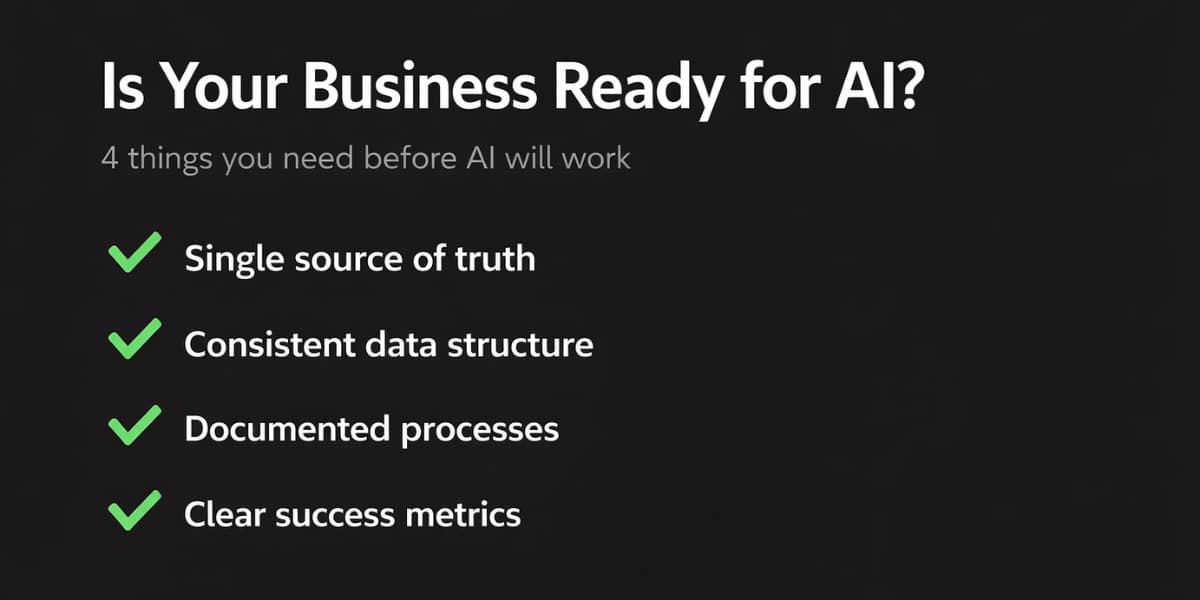
Before spending on AI implementation, check these four things. Be honest about each one.
A single source of truth. Does your business data live in one place, or is it scattered? Client records, project data, financial data, team capacity, it should all be queryable from one system. If it’s not, that’s step one. This is the Company Brain work we wrote about in What is a company operating system?, building a data layer that everything else can run on.
Consistent data structure. Even if you have one central tool, the data inside it matters. Are client names formatted consistently? Are statuses using the same values across all records? Are dates stored as actual dates, not text? Are you tracking the same fields for every project, or does each one have slightly different information? Inconsistent data creates inconsistent AI output. There’s no way around this.
Documented processes. For every workflow you want to automate or augment with AI, you need to be able to write down the steps. Not the ideal steps, the actual steps, including the edge cases and the things that only one person on your team currently knows how to handle. If you can’t write it down clearly, you can’t automate it. This work feels slow. It’s also the work that makes everything built on top of it durable.
Clear success metrics. What does “working” look like for this specific AI implementation? How many hours per week should it save? What error rate is acceptable? How will you know in 30 days whether it’s delivering value? If you can’t define success before you build, you’ll spend months adjusting scope and never know whether the project succeeded.
A quick self-assessment
Here’s a practical way to check your own AI readiness. Answer each question honestly, not how you want the answer to be, but how it actually is today.
Can you pull a complete view of all active clients, their current project status, and any revenue at risk in under five minutes, without asking anyone for help? If the answer is no, your data isn’t consolidated enough yet.
Is your client onboarding process the same every time, same steps, same order, same outputs, regardless of who’s running it? If different people do it differently, you don’t have a documented process, you have a habit.
When a team member needs context on a client or a project, is there one place they go? Or does finding that context require checking email, a project tool, a spreadsheet, and potentially asking someone? If it’s the latter, you don’t have a single source of truth.
Could a new hire understand how your core operations work from documentation alone, without sitting down with you for a full walkthrough? If the answer is no, the knowledge is still in people’s heads instead of the system.
If you answered yes to all four: your foundation is likely solid enough to start scoping AI. If you answered no to two or more: the foundation work comes first, and that’s the right call. Businesses that build the infrastructure before layering on AI get dramatically better results than ones that go the other direction.
What to do if you’re not ready yet
“Not ready yet” has a clear path. The work is operations consulting, process documentation, data architecture, and building a system your whole business runs on. Once that foundation is in place, adding AI isn’t a leap. It’s a natural extension. You’re adding intelligence on top of something that can actually support it.
The mistake is treating AI readiness as a technology problem. It’s an operations problem first. The technology comes second.
This is also where the framing of “we need to do AI” can work against you. The businesses that get the most out of AI aren’t the ones who prioritized AI. They’re the ones who prioritized getting their operations right, and then found that AI worked extremely well on top of a clean foundation. GDP Inc was a good example of this. The AI layer came after we had their client data centralized and their operational processes documented. By that point, the AI implementation was relatively straightforward because we knew exactly what we were building on.
The first step is knowing where you stand. That’s where we start: we look at your data layer, your process documentation, your tool stack, and your automation readiness, and give you a clear, honest picture of what to address first and what to save for later.
If you run a service business and you’re wondering whether you’re ready for AI, or whether you need to fix something first, book a call. We’ll walk through it with you, and usually surface things most businesses didn’t know were a problem.