01
Operations Audit
The audit maps how your operations actually run, department by department, and shows you where the week goes.
Most audits find 15 to 30 percent of a team's week going into work a system should be doing.
Operations Consulting
An operations audit maps how your team works today. From there we write the SOPs they can follow and build the operating system that holds it together.
Speak With Us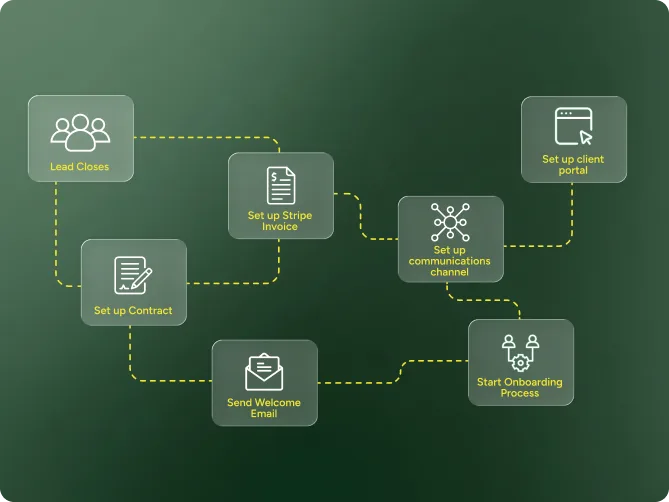
What we do
The audit maps how your operations actually run, department by department, and shows you where the week goes.
Most audits find 15 to 30 percent of a team's week going into work a system should be doing.
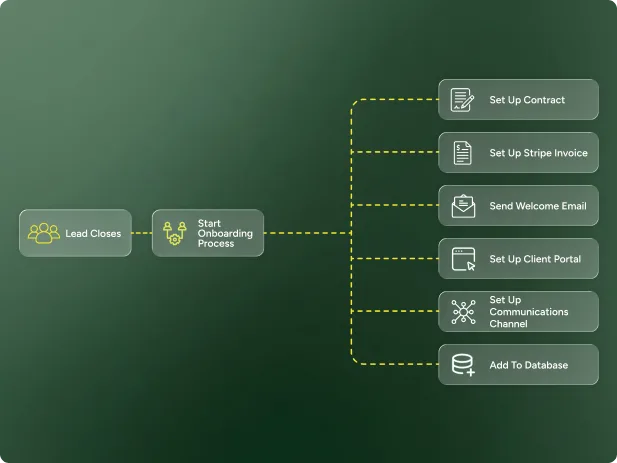
We redesign the processes the audit flagged and specify them so they can be built: who does what, in what order, and what happens when something stalls.
Documented workflows cut onboarding time by 40–60% on average.
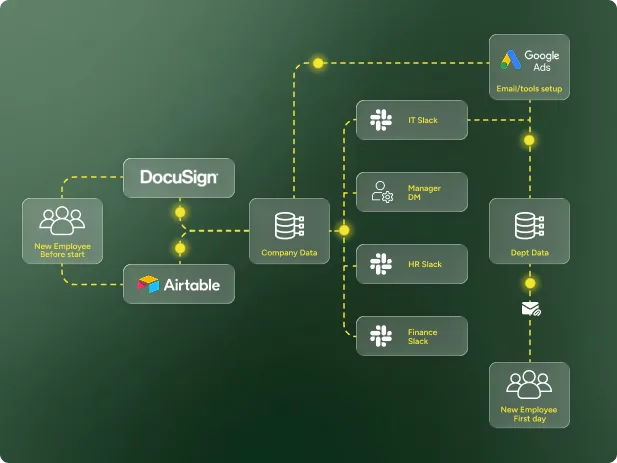
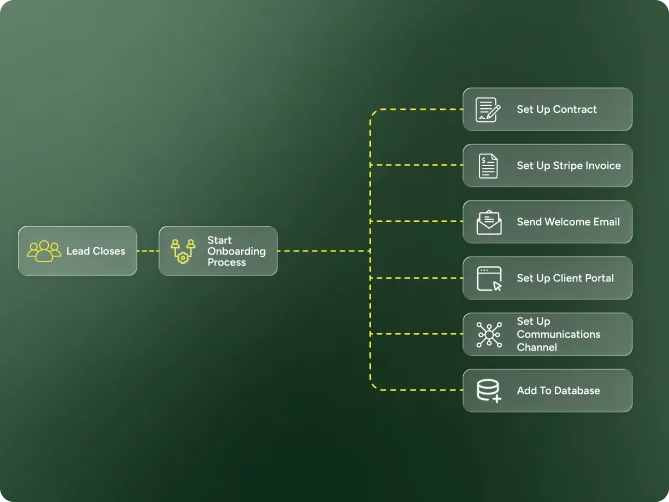
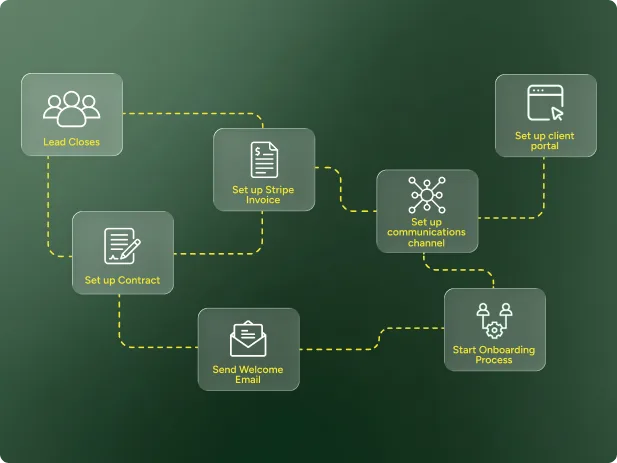
We map each department with the people who run it and connect the roles across departments. The process map becomes a visual SOP a new hire can follow on day one, with written steps where exact settings matter, and we build the routine that keeps it current.
Businesses with documented SOPs onboard new hires 40–60% faster and reduce dependency on any one person.
Key takeaways
An operations consultant studies how a business actually runs, its processes, tools, roles and data, and redesigns them so the work gets done with fewer manual steps and fewer dropped tasks. Large firms such as McKinsey, Bain and BCG do this for enterprises. For a service business the work is more hands-on: mapping, redesigning and building the system.
The difference matters because a service business rarely needs a report on its operating model. It needs the client onboarding that runs on back-and-forth emails to run on its own, and the numbers leadership asks for to be there without anyone assembling them by hand.
Operations consultants find where a business loses time and information, then fix the processes behind it. In practice the work runs in stages: an audit of the tools and data, process maps of each department, redesigned workflows, the build itself, a handover with training, and support once the system is live. Each stage leaves the client with something.
| Stage | What happens | What you keep |
|---|---|---|
| Operations audit | Every tool, data source and process is inventoried, and the places where hours and information leak are found. | A prioritised list of fixes. What happens in an operations audit |
| Process mapping | Each department's processes are mapped with the people who run them, and every handoff between departments is marked. | Visual SOPs your team can follow. How we map a business |
| Workflow design | The flagged processes are redesigned: who does what, in what order, and what happens when something stalls. | A specification that can be built |
| The build | The system is built on the tools that fit, often Airtable and Softr, connected through Make or n8n. | A system that belongs to you |
| Handover | A full system handover, Loom video documentation of how it works, and scheduled training for your team. | Documentation and trained people. What a handover includes |
| Ongoing support | Maintenance as the business changes, a shared Slack channel, and monitoring of the automations when we stay on. | Someone who already knows the system |
The best-known operations consulting firms are McKinsey, Bain and BCG, along with the operations practices of the Big Four accounting firms. They mostly serve large enterprises. Small and mid-sized service businesses are usually better served by a boutique firm that builds the system as well as advising on it, which is the kind of firm Catalytics Automation is.
The way to judge any firm in that second group is by measured results with named clients. Ours are public. Affinity Care moved from five disconnected tools to one Airtable base, cut caregiver onboarding from 21 days to 8, and saves its operations manager 15 hours a week. Nomads Cast replaced an eight-step manual client onboarding with an automated one that finishes in under a minute and saves five hours per client.
After the build, the client gets a full system handover, Loom video documentation of how the system works, and scheduled training. Everything we build belongs to the client. Ongoing maintenance and support continue after launch, every client has a shared Slack channel with us, and when we stay on as system administrators, the automations are monitored.
Whether the system lasts depends mostly on change management inside the client's team: a rollout plan, training, and buy-in. We recommend the rollout and run the training, and software adoption in a small team covers the part only the client can do.
The business operating system
Every system is built on the same foundation, and each layer depends on the one below it.
We map how your business really works and document the processes your team and your tools can both follow.
One system your whole team runs on: the custom tools, connected data, and automations that replace the manual work.
Intelligence that works because it has something clean to operate on. Workflow automation and AI layered on everything below.
How it works
A few working sessions and access to your tools. We document how your business actually runs today, not how the org chart says it does.
We design and build your operating system layer by layer, reviewing with you as we go. Nothing gets built that you haven’t seen.
We hand it over and train your people.
We can stay on as your system administrators, watch how it runs day to day, and keep improving it as your business grows and changes.
Results
 Healthcare
Onboarding cut from 21 days to 8
Rebuilt their entire caregiver onboarding process. What took 21 days now takes 8.
Affinity Care
Read the case study → Agency
99% faster onboarding
Consolidated six disconnected tools into one operating system. An 8-step onboarding that used to take hours now finishes in under a minute, with five hours saved per client.
Nomads Cast
Read the case study →FAQ
Operations consulting examines how your operations actually run: the processes, the tools, the team structure and the data. It then redesigns them so the company can grow without adding headcount at the same rate.
An operations audit ends with a written map of your current processes, a prioritised list of what to fix, the SOPs for the processes we rebuild, and the operating system itself once it is built. Everything is yours to keep and to run without us. What happens in an operations audit walks through the whole exercise, and what a system handover includes covers the end of the build.
A fractional COO is a part-time executive who manages operations on an ongoing basis. We're different: we come in, design your business operating system, build it, and hand it over. You get the result without the ongoing salary. The goal is always to make you self-sufficient.
The audit is a fixed-scope diagnostic. How long it runs depends on how many departments it covers and how much of the process is already written down, and you get the scope and the timeline in writing before we start, so nothing is open-ended. It ends with a prioritised roadmap, quick wins first, so you see the full picture and the order of work before committing to any build.
We implement. The audit ends in a roadmap, and then we build what it calls for: the workflows, the SOPs and the operating system your team runs on. You are not left with a slide deck and a to-do list.
Service businesses with roughly 10 to 150 people. Small enough that the founders still see every process, large enough that the processes no longer fit in their heads. If you are a two-person shop or a thousand-person enterprise, we are probably not the right fit, and we will say so.
Yes. A large share of our work is with healthcare and financial services companies, where the redesigned processes have to carry compliance with them. We build HIPAA-compliant systems for healthcare clients, so the audit accounts for what the rules allow before anything is redesigned.
We're tool agnostic, meaning we build using both no-code and code. Our no-code speciality is Airtable and Softr.
We price by project. Book a call and we'll give you a straight answer based on your situation.
Let’s get to work
Right now your business runs on a stack of tools that don’t talk to each other. That’s the problem we solve. Tell us what’s slowing you down and we’ll show you what one system would look like for your firm.