Key takeaways
- A CRM won’t fix home care operations. What’s needed is an operations system that connects clients, caregivers, referrals, billing, and compliance in one place.
- Generic CRMs (HubSpot, Salesforce) have no concept of authorized hours, multiple payers per client, or expiring caregiver credentials, the fields home care actually runs on.
- A real home care operations system tracks: caregiver credential expiration alerts, client intake pipeline, EVV-to-billing reconciliation, and audit-ready compliance documentation.
- Catalytics has built this for three Minnesota home care agencies. Affinity Care cut caregiver onboarding from 21 days to 8 and now sits audit-ready every day.
If you’re searching for the best CRM for home care, I’ll tell you upfront: the software isn’t the problem.
Client data lives in one spreadsheet. Caregiver certs live in another, probably with a tab for each person, managed by whoever has time this week. (The point where a spreadsheet stops being the right tool is usually well behind you by then.) Referrals come in by phone and email and get tracked in someone’s inbox or a shared Google Doc that nobody fully trusts. Billing and authorization hours are in a third spreadsheet. Your compliance documentation is scattered across folders that made sense two years ago and don’t anymore.
You don’t have a CRM problem. You have an operations problem. A CRM won’t fix it. What will fix it is an operations system, a single platform where every piece of data about your clients, caregivers, referrals, billing, and compliance is connected, accurate, and updated automatically. The general version of that build, which processes to automate first and in what order, is in the business process automation guide.
That’s what a growing home care agency actually needs. Here’s what it looks like, and why most crm for home care searches end in frustration.
Why do generic CRMs fail home care agencies?
Standard CRMs, HubSpot, Salesforce, Pipedrive, are built for sales teams. A “contact” in HubSpot is someone you’re trying to close. It has no concept of a client who is also a payer source with authorized hours across multiple funding streams, or a “team member” who has first aid certifications that expire in six weeks and triggers regulatory liability when they do.
The home care-specific software options are better suited to scheduling and billing, but they create their own problems. Most of them lock your data inside their platform, don’t integrate cleanly with other tools, and give you reporting based on what they decided to track, not based on what your business actually needs to see.
What I hear from home care agency owners consistently: they’ve tried two or three tools, and they’re still doing significant manual work to bridge the gaps. Caregiver credentials tracked in the software but expiration alerts going nowhere. Referrals logged in the CRM but no one following up systematically. Billing tracked in one system, authorization hours tracked in another, and someone reconciling them by hand every month.
The crm for home care that actually solves the problem isn’t a single software product. It’s a system built around how home care operations actually work.
What must a CRM for home care agencies track?
When I build a CRM for home care agencies, there are six operational areas it needs to cover, not two or three. Most off-the-shelf tools handle two or three. A custom-built system handles all six, connected.
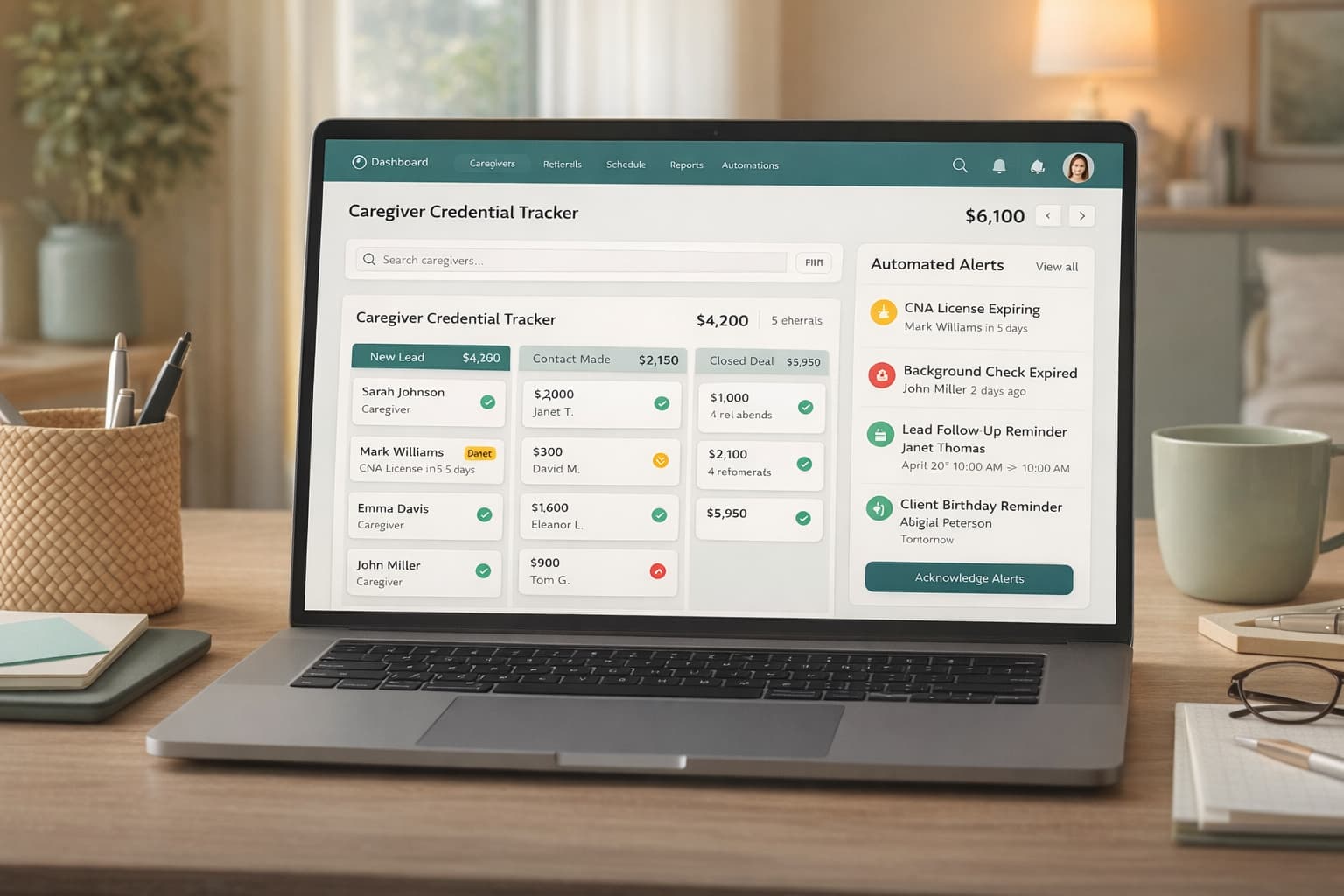
Caregiver credential tracking. Every active caregiver has a set of certifications, background checks, and training requirements that must be current to stay compliant. The system tracks expiration dates and sends automated alerts before anything lapses, not after. The question “is everyone in good standing right now?” should take 30 seconds to answer, not an afternoon.
Referral pipeline. Home care agencies lose $5,000–$15,000 per dropped referral. Referrals come in from hospitals, social workers, family members, and health plans, through different channels, with different urgency levels. The system captures every inbound referral, assigns follow-up automatically, and tracks each one through to enrollment or decline. Nothing falls through because someone forgot to add it to a spreadsheet.
Billing and authorization tracking. Every client has authorized hours from their payer source. Those hours need to be tracked against actual service delivery, with alerts when authorizations are approaching their limit or expiration. The system connects billing to service records so you’re not reconciling two spreadsheets at the end of every month.
Compliance documentation. Service agreements, care plans, annual reviews, meeting records, each tied to the right client, with status tracked through every stage. Anything approaching a deadline surfaces automatically. Pre-audit scrambles are replaced by a dashboard that’s accurate every day.
Client records. Every client’s full history: services authorized, visits delivered, notes from coordinators, contacts for responsible family members, and current care plan status. One place, always current.
Automated alerts. The work that used to fall through because no one had time to track it, follow-ups on expiring credentials, pending authorizations, lapsed referrals, upcoming review deadlines, moves from someone’s to-do list to automated triggers that fire on schedule.
Purpose-built beats general-purpose
Running your agency on spreadsheets and a generic CRM?
We build home care operations systems that track all six areas, connected: credentials, referrals, authorizations, compliance, client records, and the alerts between them.
See what a purpose-built system looks likeWhat we built for three Minnesota agencies
AffinityCareMN came to us with five disconnected tools and a compliance team spending most of the week before every audit reconciling documents that should have been organized all along. Their home care caregiver credentialing was tracked in spreadsheets that were always slightly out of date. Leadership was making decisions on data assembled by hand, days after the fact.
We consolidated everything into a single Airtable system. We build on Airtable so you easily comply with HIPAA. Caregiver records, client information, service documentation, compliance tracking, and reporting, all in one place, with automated workflows replacing the manual data entry that had consumed 15 hours a week of the operations manager’s time. Caregiver onboarding dropped from 21 days to 8.
“With the help of Catalytics we have been able to restructure our data, interpret it, and build the necessary processes to set our business up for continued growth and expansion.”, Affinity Care Leadership
“We used to spend the whole week before an audit just trying to figure out if everyone’s documents were current. Now it’s always current. I don’t even think about it.”, Affinity Care Operations
C.A. Ellis & Associates manages compliance operations for more than a dozen care provider organizations simultaneously, a two-level problem that no spreadsheet could hold. Provider compliance status was discovered when clients called to ask questions, not when the system flagged them in advance. Documents had to be manually routed between platforms every time one was signed or expired.
We built a three-layer system: an Airtable data architecture that handled the full provider-to-client compliance hierarchy, full automation that routed documents and surfaced compliance alerts without anyone touching them, and a client-facing portal where each provider could see their own compliance status without calling.
The result: “Compliance gaps were discovered when clients called asking questions, not when a system flagged them in advance” is no longer how they operate. Providers self-serve. Documents route automatically. The phone calls that used to consume staff time stopped coming.
Minnesota Care Counseling Services, a care counseling agency operating since 2013, faced a version of the same problem: operational data scattered across tools with no single picture of where the organization stood. Consolidating into a structured system gave their team the visibility to operate proactively instead of reactively.
What makes a home care CRM different from a sales CRM?
| Sales CRM (HubSpot, Salesforce, Pipedrive) | Home care CRM (operations system) | |
|---|---|---|
| A client is | A contact you are trying to close | A person with authorized hours across one or more payer sources |
| A team member is | A user seat | A caregiver with certifications that expire and trigger liability |
| Referrals | A deal pipeline | Multi-channel intake (hospitals, social workers, families, health plans) tracked to enrollment or decline |
| Billing | Invoices sent | Authorized hours reconciled against delivered service and EVV records |
| Compliance | Not modeled | Service agreements, care plans and reviews with deadlines that surface themselves |
| Reporting | Sales dashboards | Audit-readiness, credential status, authorization burn-down |
Frequently asked questions
What is the best CRM for a home care agency?
The best CRM for a home care agency is the one that covers all six operational areas the work actually runs on, and no off-the-shelf tool does, because the job is not a sales pipeline. A home care CRM has to track caregiver credentials, referral pipeline, billing against authorized hours, compliance documentation, client records, and automated alerts, and most tools cover two or three. The agencies we work with get there with a system built on Airtable that covers all six, connected.
What features should a home care CRM have?
A home care CRM needs credential expiration tracking with alerts that fire before a lapse, referral capture from every channel with assigned follow-up, authorization tracking tied to service delivery and EVV, compliance documents with surfaced deadlines, complete client records in one place, and automated alerts that replace someone’s mental to-do list. A tool missing any of these leaves that area to manual work, every week.
Can you use HubSpot or Salesforce for a home care agency?
As a home care CRM, no, though either works for sales-style pipeline tracking. Neither has a native concept of authorized hours, multiple payers per client, or expiring caregiver credentials, and those are the fields home care actually runs on. Agencies that try end up bridging the gaps by hand in spreadsheets around the CRM.
Does this work for multi-location or multi-entity providers?
Yes. A home care CRM built as an operations system handles hierarchy that flat tools cannot. C.A. Ellis & Associates manages compliance for more than a dozen provider organizations at once, a two-level hierarchy no flat CRM models. The same architecture handles an agency with multiple locations that needs one central view of intake and occupancy across all of them.
We built operations systems for AffinityCareMN, C.A. Ellis & Associates, and Minnesota Care Counseling Services. If your agency is running on spreadsheets or hitting the ceiling of your current tools, book a 30-minute call, we’ll show you what a purpose-built system looks like for your specific situation. For more on how we approach healthcare operations specifically, and for the data foundation that sits under all of this, our Airtable consulting page covers what a custom build actually involves.